Sliding Doors
Sliding doors solve a problem hinged doors can't. If there's a vanity, a toilet, or a doorway within the arc a swinging door would need, you can't install a hinged shower door at all without rearranging the bathroom. Sliders take that arc out of the equation and let the glass move along a track instead.
What Sliding Really Means
Modern shower sliders use a top-mounted track (sometimes with a bottom guide, sometimes without) that carries one or more panels of tempered glass. One panel is typically fixed, and a second panel rolls along the track past it. To open the shower, you push the rolling panel over toward the fixed one, which exposes the opposite side as your entry.
The old bottom-track-plus-top-track sliders are still out there, but we don't sell them anymore — they collect soap and mildew and feel dated the moment they're installed. Every sliding door we ship uses a modern header-mounted system, where the weight of the glass hangs from the header and the bottom is guided without being trapped.
Single Slider vs. Double Bypass
A single slider pairs one fixed panel with one moving panel. It's the cleanest look — half the glass is stationary, half slides. Single sliders work great in openings 48 to 72 inches wide where you only need to open one side for entry. They're also the cheapest slider configuration because there's less hardware involved.
Double bypass (sometimes called "double sliding") uses two moving panels that can both slide along the track. Opening the left panel gives you left-side entry; opening the right gives you right-side entry. This makes sense for wide openings where you might want to enter from either side depending on where you're standing, or in bathrooms shared by two people who have different habits.
Corner Sliding Doors
Sliding corner enclosures are a specialty configuration worth calling out. You get one sliding door on one wall of a corner shower plus two fixed panels wrapping the 90-degree corner, so the door glides along the track while the panels stay anchored against the tile. This works for corner showers 36 inches or wider on the sliding side.
The hardware for sliding corners is more involved than for a straight slider, because the top track has to tie into a vertical corner support that holds the fixed panels in place. It's not something every bathroom needs, but when the layout calls for it there's no other clean option.
When Not to Buy Sliding
Sliders are the wrong choice for narrow openings. Below about 48 inches of total width, the two panels don't leave you enough opening to enter comfortably — you end up with a 20-inch gap and a bruised shoulder. For narrow showers, a single hinged door is always better.
Sliders also aren't ideal for steam showers. They don't seal top to bottom the way a hinged door with a transom does, so steam escapes through the top of the track assembly. If you're planning a steam build, look at the door and fixed panel category instead.
Hardware and Track Quality
Sliding door hardware takes more abuse than any other category. Every open-and-close cycle puts stress on the rollers, the track, and the mounting bolts. We use only heavy-duty track assemblies with stainless steel rollers, and every slider ships with the correct soft-close or hard-stop stops based on your configuration.
Finish options are the same five as our other doors: Brushed Nickel, Chrome, Matte Black, Bronze Anodized, and Oil Rubbed Bronze. The track is the most visible piece of hardware on a slider — more visible than hinges on a hinged door — so think about which finish plays best against your tile color and wall paint before ordering.
Inspect your shipment before you sign for it. Freight damage must be noted on the delivery receipt at the time of delivery. Look over the crate and the glass while the driver is still there, write any damage on the receipt before you sign, including damage to the packaging, and report it to us within the deadline in our shipping policy. Signing a clean receipt for damaged freight limits what can be claimed.
A few other things to know:
- Your glass is made to measure and built after your order is placed, so there is a production window before it ships. Production time varies with product type, glass thickness, hardware finish, material availability and manufacturing capacity, and estimated times are not guaranteed.
- Because the panels are oversized and fragile, they ship by freight rather than standard parcel. The carrier and service are chosen based on size, weight, destination and availability.
- Shipping cost is calculated at checkout from your destination, order size and weight, freight class, residential or commercial delivery, and any liftgate or limited-access service required.
- Someone must be there to receive it. The carrier contacts you to schedule delivery, so stay reachable and check that your shipping address is correct. Plan on having help available to take in oversized freight; refused deliveries and storage can add carrier fees.
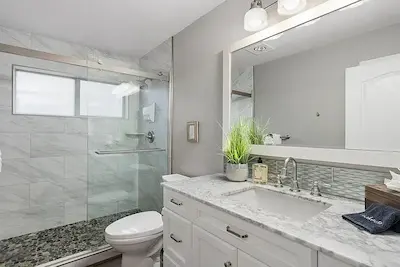
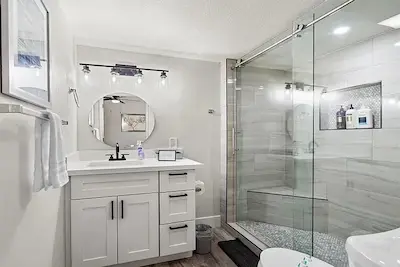
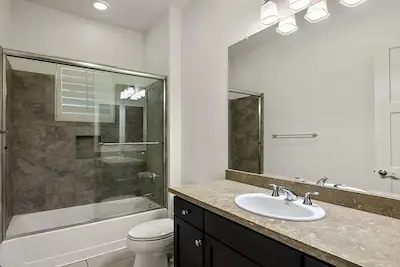
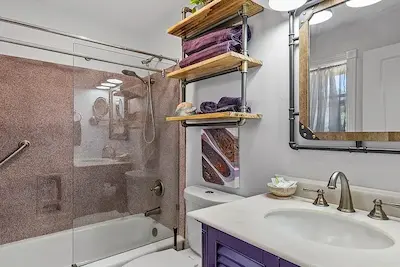
Project Gallery
You May Also Like
Customer Reviews
- Saved a narrow layout
- Tint warmed the room
- Cut to suit, no fuss
- Still one-finger smooth


