Angle Doors
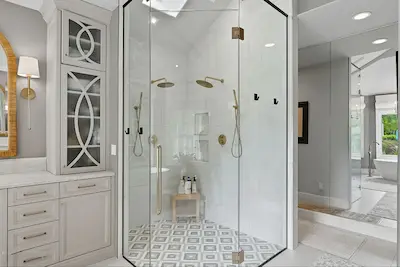
Angle doors are the pentagon of the shower world. Instead of a door meeting a panel at a sharp right angle, the two pieces come together at 135 degrees, creating a softer geometry that carves out useful floor space without forcing you to commit to a full corner enclosure.
What a 135-Degree Angle Does
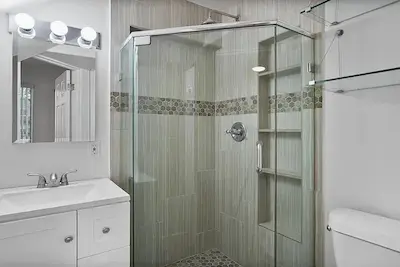
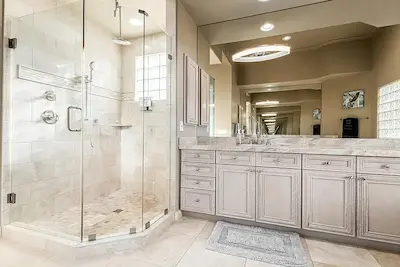
A standard corner shower gives you two tile walls at 90 degrees and a glass door at the corner. An angle shower replaces that hard corner with a diagonal cut, so one side of the enclosure has a tile wall, the other side has another tile wall, and the glass forms a chamfered front that hinges outward at a 135-degree break. You gain a few inches of interior space compared to a right-angle corner, and the bathroom reads softer because there's no sharp point sticking into the room.
This is the layout people in the tile trade call "neo-angle." We call it angle to keep things simple, but the geometry is the same.
Single Door Plus One Panel
The most common angle configuration is a hinged door plus one fixed panel meeting at 135 degrees. The door opens outward the way any hinged door does, and the fixed panel handles the other half of the diagonal front. This works for shower footprints between 36 and 48 inches on each side, which covers most retrofits where a bathroom has space for a corner shower but no clean 90-degree corner to put it in.
You can also add a knee wall under the fixed panel, which lowers the glass height on that side and makes the enclosure read as more open. Knee wall angle builds are particularly good in primary bathrooms where you want the shower to feel integrated with the rest of the space.
Multi-Panel Angle Builds
More complex angle configurations exist for larger showers. One common variant is the door with four fixed panels, where the door handles the front entry and four smaller panels wrap the rest of the enclosure at varying angles. Another is the door with steam shower panels and a transom, for when the angle shower needs to double as a steam room.
These bigger builds are almost always custom-measured by a contractor or glass installer, not by the homeowner. If that's what you're planning, have your installer pull the measurements and send them to us — the tolerances on multi-panel angles are tighter than on any other layout we sell.
When Angle Beats Corner
Angle is worth the extra cost when you want a corner shower that doesn't feel like a box. The 135-degree cut softens the geometry, opens up the entry path into the shower, and visually pushes the enclosure out into the room instead of trapping it against the walls. It also reads as more upscale than a standard 90-degree corner, which matters in primary bathrooms and higher-end remodels.
Angle is not worth the cost in tight secondary bathrooms where a corner shower is just the practical answer. Save the angle configuration for the rooms where aesthetics drive the decision.
Measuring an Angle Install
Angle showers require more measurements than any other category. You need the length of both tile walls, the length of the diagonal across the front, and the angle at which the diagonal meets each tile wall. In theory those angles should be 135 degrees on each side — in practice, wall construction is rarely that precise, and the actual angle often comes in at 132 or 138. That difference matters when we cut the glass.
Have a contractor measure your angle shower if possible. If you're measuring yourself, use a digital angle finder (not a paper protractor), and send us photos of the installed tile before ordering. We'd rather catch a measurement issue at the quote stage than after the glass is cut.
Inspect your shipment before you sign for it. Freight damage must be noted on the delivery receipt at the time of delivery. Look over the crate and the glass while the driver is still there, write any damage on the receipt before you sign, including damage to the packaging, and report it to us within the deadline in our shipping policy. Signing a clean receipt for damaged freight limits what can be claimed.
A few other things to know:
- Your glass is made to measure and built after your order is placed, so there is a production window before it ships. Production time varies with product type, glass thickness, hardware finish, material availability and manufacturing capacity, and estimated times are not guaranteed.
- Because the panels are oversized and fragile, they ship by freight rather than standard parcel. The carrier and service are chosen based on size, weight, destination and availability.
- Shipping cost is calculated at checkout from your destination, order size and weight, freight class, residential or commercial delivery, and any liftgate or limited-access service required.
- Someone must be there to receive it. The carrier contacts you to schedule delivery, so stay reachable and check that your shipping address is correct. Plan on having help available to take in oversized freight; refused deliveries and storage can add carrier fees.
Project Gallery
You May Also Like
Customer Reviews
- No sag after six months
- Nobody else would quote it
- Better in person
- Wipe it more often


