Fixed Panels
A fixed panel is the purest version of a shower enclosure: one sheet of tempered glass standing between your shower spray and the rest of the bathroom. No hinges, no handles, no moving parts. Some people call it a splash guard, some call it a shower screen. Both are right.
What a Fixed Panel Does
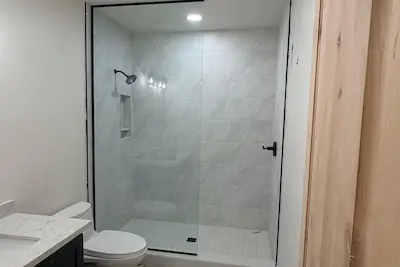
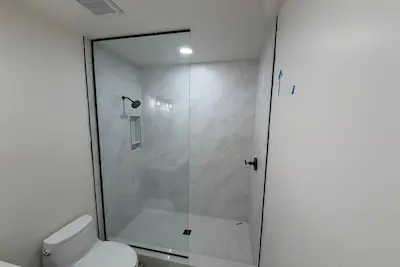
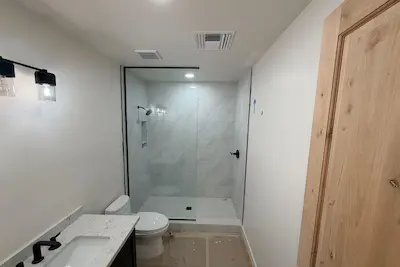
It blocks spray. That's the entire job. Depending on how it's positioned, a fixed panel can define a full walk-in shower (where you walk around the edge of the panel to enter), or it can sit next to a tub to keep water off your floor, or it can cap the front edge of a bench in a steam room. The panel itself has no moving parts, which is exactly why people buy it.
Our single-panel orders come in two forms: a wall-mounted screen that runs from the floor up, and a panel that mounts to a knee wall or half partition. Either way, the glass is cut to your opening and anchored with clamps or a U-channel along the base and one vertical edge.
Why Go Doorless
A walk-in shower without a door reads as more open, feels more spacious, and requires zero maintenance on moving parts. There's nothing to stop closing correctly, nothing to pinch a towel on, and nothing to replace after a decade of humidity. For people building a primary bathroom from scratch, doorless is often the aesthetic target, and a fixed panel is the cheapest way to get there.
The tradeoff is spray control. Your shower has to be deep enough that water doesn't reach the opening. Forty-two inches of depth is a reasonable minimum; sixty is comfortable. Less than that and you're going to mop the floor every time you shower.
Splash Guard Use Cases
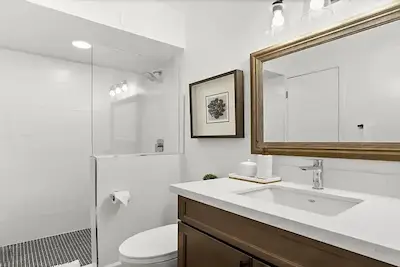
Fixed panels also work as companion pieces to other layouts. A small panel next to a freestanding tub catches spray from a wall-mounted shower head. A panel above a bench wall stops water from launching over the top. A partial panel on a knee wall bridges the gap between tile and glass in a steam enclosure.
If you're not sure whether you need a full walk-in panel or a smaller splash guard, measure the distance from your shower head to the nearest dry surface. If that number is under 48 inches, you want a full-height panel. Over 60, a shorter splash guard usually does the job.
Glass Weight Matters More Here
Because a fixed panel has no header or secondary panel bracing it, the glass itself has to do all the structural work. That's the one place where we push the 1/2-inch thickness upgrade pretty hard. Three-eighths glass is fine for most panels under 36 inches wide, but beyond that the thicker panel resists flex and feels more anchored when you brush against it.
Height also matters. Anything taller than 72 inches should be 1/2-inch, no exceptions. A tall, wide fixed panel in 3/8 glass will work — but it will always feel less substantial than the same panel in 1/2.
Hardware and Finish
Fixed panels use the same clamp or U-channel hardware menu as our doors. U-channel is the lower-cost option and runs along the base of the glass, hiding the raw edge where it meets the floor tile. Clamps mount the glass at two or three points instead of a continuous channel and show more glass. We prefer clamps on panels under 42 inches wide and U-channel on anything wider, mostly because the continuous support holds better over time.
Finishes are Brushed Nickel, Chrome, Matte Black, Bronze Anodized, and Oil Rubbed Bronze. Pick the one that matches your fixtures and move on — this isn't a decision that rewards agonizing.
Inspect your shipment before you sign for it. Freight damage must be noted on the delivery receipt at the time of delivery. Look over the crate and the glass while the driver is still there, write any damage on the receipt before you sign, including damage to the packaging, and report it to us within the deadline in our shipping policy. Signing a clean receipt for damaged freight limits what can be claimed.
A few other things to know:
- Your glass is made to measure and built after your order is placed, so there is a production window before it ships. Production time varies with product type, glass thickness, hardware finish, material availability and manufacturing capacity, and estimated times are not guaranteed.
- Because the panels are oversized and fragile, they ship by freight rather than standard parcel. The carrier and service are chosen based on size, weight, destination and availability.
- Shipping cost is calculated at checkout from your destination, order size and weight, freight class, residential or commercial delivery, and any liftgate or limited-access service required.
- Someone must be there to receive it. The carrier contacts you to schedule delivery, so stay reachable and check that your shipping address is correct. Plan on having help available to take in oversized freight; refused deliveries and storage can add carrier fees.
Project Gallery
You May Also Like
Customer Reviews
- Nothing to scrub
- Measured it myself
- Beat three local quotes
- Flawless panel, slow arrival


